Export-Ready Documentation Habits for Food Ingredient Premix Suppliers
Export delays rarely begin at the port. They usually begin earlier, in the quote file, the supplier approval packet, the lot record, or the label copy that no one reconciled against the commercial invoice.
For contract food ingredient blenders, enzyme-containing premixes add another layer of control. A food enzyme may be only one component in a finished blend, but it can drive documentation questions around origin, allergen status, processing aids, certification, shelf life, transport condition, and lot traceability.
That is why bulk food enzyme sourcing for ingredient blenders should be managed as a documentation workflow, not just a price negotiation.
BatchLoom supports procurement teams that need food enzyme supply to fit into approved supplier systems, export customer requirements, and repeat production schedules. The habits below help keep premix exports cleaner, faster, and less exposed to last-minute substitution risk.
Start with the destination market, not the enzyme list
A premix specification may look stable internally, but export requirements shift by customer, country, distributor, and application. Before confirming a food enzyme source, define the export documentation set needed for the intended lane.
Common items to confirm early include:
- Commercial invoice data requirements
- Packing list format and pack-size visibility
- Certificate of analysis expectations
- Certificate of origin or origin statement needs
- Safety data sheet language and format
- Allergen declaration format
- GMO position statement, where requested
- Halal, kosher, or other certification requirements
- Shelf-life statement and storage conditions
- HS code alignment and product description discipline
- Lot traceability expectations from enzyme lot to premix lot
The goal is not to collect every document possible. The goal is to collect the right documents before the purchase order becomes urgent.
Build supplier approval around repeatability
For ingredient blenders, a supplier approval file should answer one operational question: can this enzyme source support repeat premix production without forcing new paperwork each time?
A strong approval packet should include:
1. A controlled specification
The specification should define the enzyme type, carrier system, physical form, declared performance range, appearance, storage guidance, shelf life, and pack format. It should be written clearly enough for purchasing, QA, production planning, and customer documentation teams to use the same language.
Avoid supplier descriptions that sound flexible but create ambiguity. If the enzyme is purchased as a powder for dry blending, the document should support that use case with clear handling, packaging, and traceability expectations.
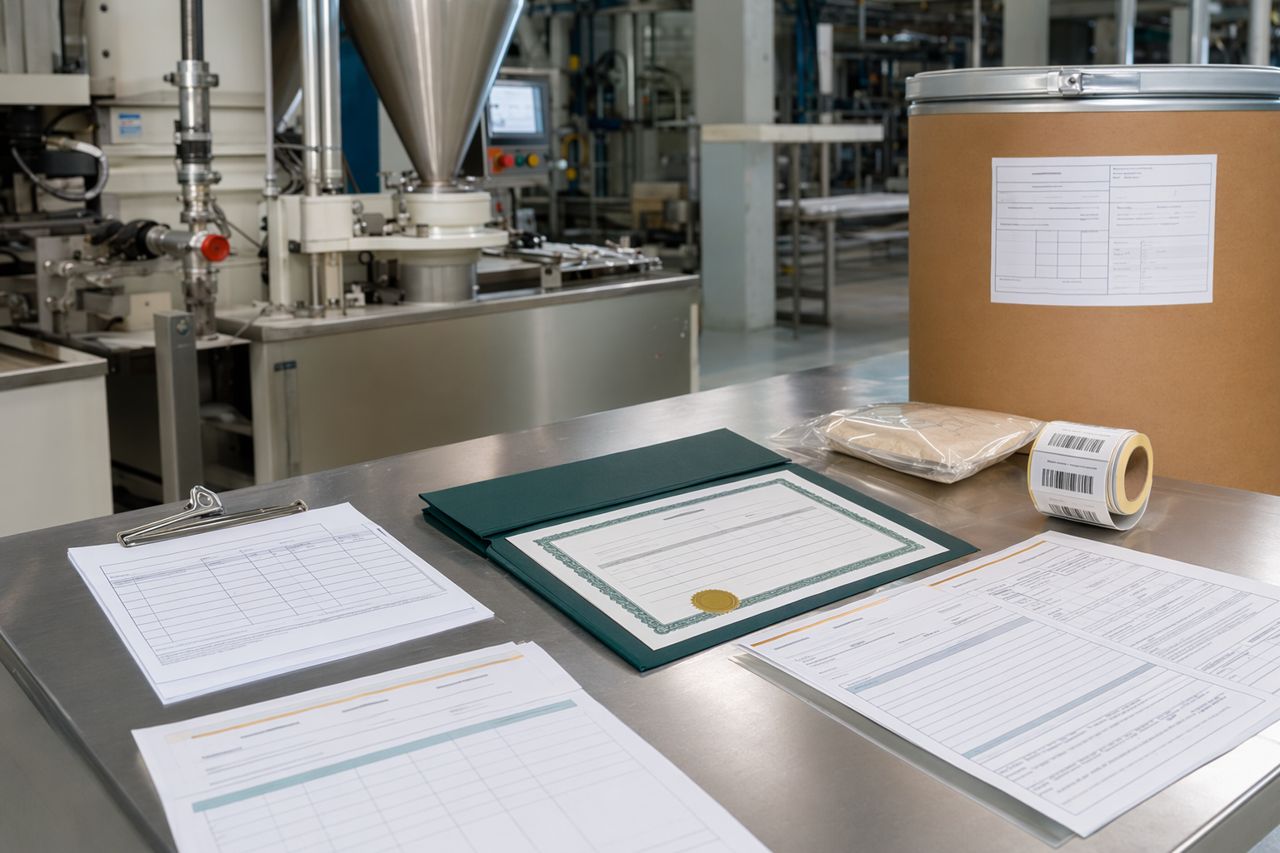
2. A current COA model
A COA should be reviewed for structure before the first shipment is booked. Procurement should confirm that it identifies the product, lot, manufacturing or release reference, relevant specification checks, date information, and supplier authorization.
The COA format matters because export customers often review it downstream. If the layout is inconsistent or missing practical identifiers, the documentation team may lose time requesting revisions after goods are already staged.
3. Lot traceability from source to finished premix
Export-ready traceability connects the enzyme supplier lot to the blender receiving record, internal batch record, finished premix lot, packing list, and customer shipment. That chain should be easy to reconstruct without searching through emails.
For enzyme-containing premixes, traceability is especially important when multiple lots are received under the same item code or when a formulation is supplied to several export customers.
Keep product naming consistent across documents
One of the most avoidable export problems is inconsistent naming. A product may be called one thing on the specification, another on the invoice, and a shortened version on the label.
Create a controlled naming rule for each enzyme ingredient and premix SKU:
- Internal item code
- Supplier product name
- Approved export description
- Label description
- Customer-facing premix name
- HS code description, where applicable
This does not need to make every document identical. It does need to make every document reconcilable.
For example, if the supplier description identifies a food enzyme powder and the invoice only uses a broad trade name, customs brokers or customers may ask for clarification. That clarification can slow release even when the product itself is compliant.
Align declarations before production scheduling
Declarations are often treated as a post-purchase task. For export premixes, they should be part of sourcing approval.
Key declarations to align include:
- Allergen status and cross-contact statements
- GMO position statements
- Animal-origin, BSE/TSE, or vegetarian suitability statements where relevant
- Halal or kosher status, if claimed to the customer
- Country of origin or manufacturing origin statement
- Food-grade suitability statement
- Storage and handling statement
- Shelf-life and retest position
If a declaration is required by the customer, it should be available before production is scheduled. If it is not available, the procurement team should know that before committing the premix delivery date.
Control substitutions with documentation gates
Ingredient blenders understand substitution pressure: a customer wants the same delivery date, an enzyme supplier has a lead-time issue, and purchasing is asked to find an equivalent quickly.
For export premixes, substitution should not be handled by price and availability alone. It should pass through documentation gates:
- Does the alternate enzyme match the approved functional role in the formula?
- Is the physical form suitable for the blending process?
- Are allergen, origin, and certification statements compatible with the customer file?
- Can the supplier provide a usable COA and traceable lot data?
- Does the pack size fit production and warehouse handling?
- Will the change require customer approval before shipment?
A lower-cost substitute can become expensive if it triggers a customer reapproval, relabeling event, export hold, or rejected documentation packet.
Treat labels as export documents
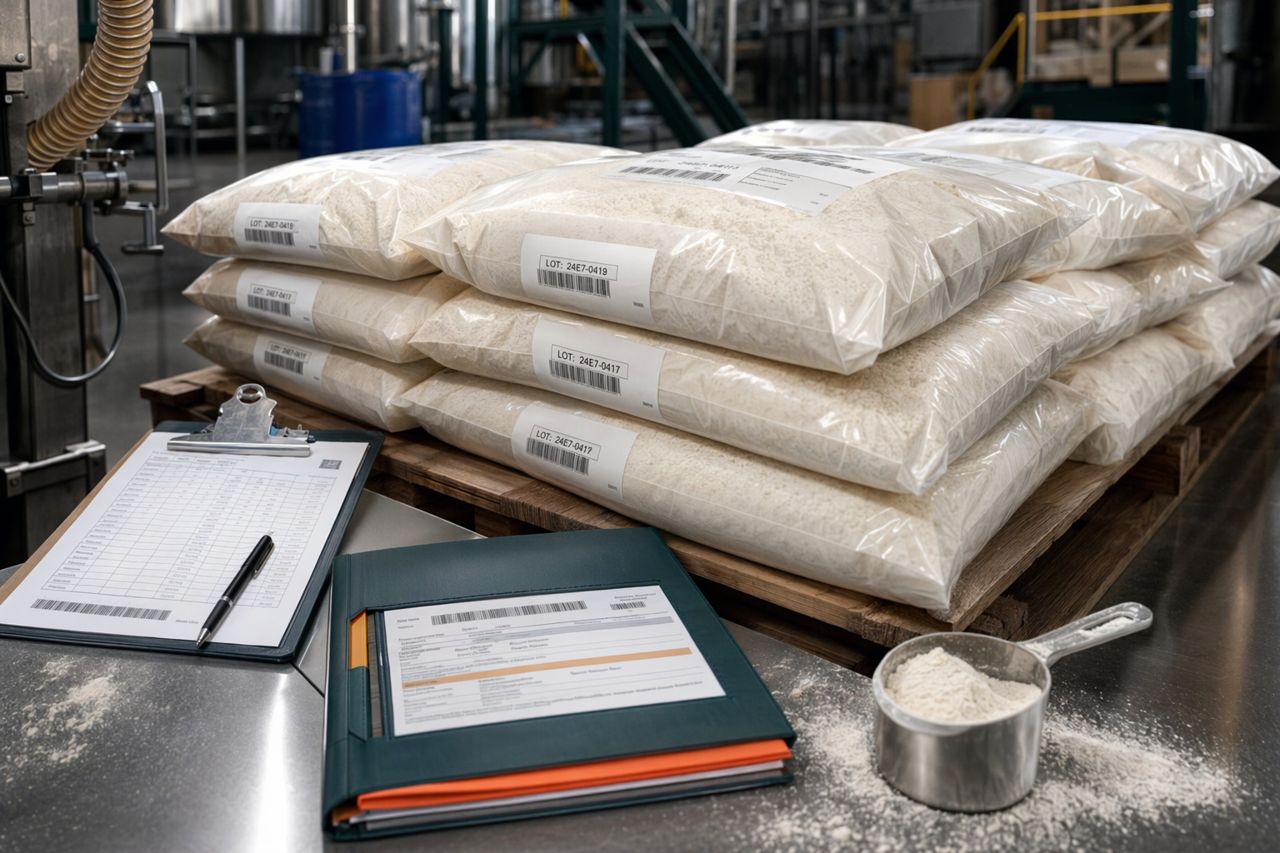
For premix suppliers, labels are not just warehouse identifiers. They are part of the export evidence chain.
Export-ready labels should support:
- Product name and internal code
- Lot or batch number
- Net weight and pack count
- Storage condition
- Production or release date, where used
- Shelf-life or best-before information, where used
- Supplier or blender identity as required
- Customer-specific markings when agreed
When enzyme ingredients are repacked into a premix, the finished product label should remain traceable to the enzyme source lots without exposing unnecessary supplier detail. This is a documentation design issue as much as a packaging issue.
Standardize document timing by purchase stage
A clean documentation habit is to define which documents are required at each stage of buying.
At supplier qualification
Collect the core specification, food-grade statement, SDS, quality system summary, general declarations, certification copies, and sample COA format.
At quote request
Confirm pack size, lead time, available documentation, origin statement, shelf-life position, and whether any customer-specific declaration will require supplier review.
At purchase order
Confirm product name, item code, quantity, pack format, requested ship date, documentation language, and any special marks needed for export shipment.
At shipment release
Receive the lot-specific COA, packing list information, invoice-ready product description, lot references, and any required certificate updates.
At premix shipment
Attach or retain the finished blend COA, finished lot record, packing list, customer declarations, and traceability link back to ingredient lots.
This staged approach reduces urgent document chasing and helps sourcing managers compare suppliers on more than price.
Watch for pack-size friction
Bulk enzyme sourcing for contract blenders is not only about cost per kilogram. Pack size can affect weighing accuracy, partial-bag control, warehouse space, exposure risk, and production changeover time.
When sourcing food enzymes for premix operations, confirm:
- Standard pack size and minimum order quantity
- Pallet configuration
- Inner liner and closure type
- Reseal or partial-use suitability
- Label readability in warehouse conditions
- Shelf-life remaining at dispatch
- Lead time for repeat orders
- Availability of the same pack format across lots
A supplier that offers attractive pricing but irregular pack formats can create avoidable handling work inside the blending plant.
Make lead time part of the compliance conversation
Lead time is not just a planning number. It determines whether procurement has time to review documents, QA has time to approve the lot, and customer service has time to confirm export paperwork.
For repeat premix programs, ask suppliers to separate:
- Standard replenishment lead time
- Document preparation lead time
- Certification update lead time
- Lead time for nonstandard pack sizes
- Lead time during holidays or seasonal demand
This is especially important when a premix customer expects stable supply and does not want formulation changes caused by enzyme availability gaps.
What BatchLoom helps procurement teams control
BatchLoom is built for sourcing managers and operations teams that need food enzyme supply to behave like an approved industrial input, not an unpredictable spot buy.
We help contract ingredient blenders evaluate enzyme options around:
- Bulk supply suitability
- Lot-to-lot consistency expectations
- Documentation readiness
- Export support requirements
- Pack-size practicality
- Lead-time reliability
- Substitution risk
- Supplier approval fit
- Quote clarity for repeat purchasing
The result is a sourcing process that supports production, QA, export documentation, and customer commitments at the same time.
Export-ready enzyme sourcing checklist
Before approving a food enzyme for an export premix, confirm the following:
- The product specification is current and controlled
- The COA format is usable for downstream customers
- Allergen and origin statements are available
- Required certifications are current and aligned with claims
- The supplier can provide lot traceability documentation
- Pack size supports the blending workflow
- Lead time fits production and export paperwork timing
- Substitution rules are documented before shortages occur
- Product naming is consistent across quote, PO, COA, invoice, label, and customer file
- The documentation set is reviewed before the first commercial shipment
A practical next step
If your team is reviewing enzyme supply for an export premix, bring the documentation requirements into the quote conversation early. It gives procurement a clearer comparison, gives QA fewer surprises, and gives production a better chance of running the same premix repeatedly without avoidable release delays.
Planning a new premix program or replacing an inconsistent enzyme source? Request a quote through the BatchLoom contact form and include the enzyme type, target application, pack preference, destination market, and documentation requirements.